

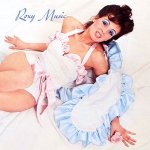

Chance Meeting (Ferry), Roxy Music, 1972
‘Chance Meeting’ is one of the more disquieting songs in the Roxy lexicon (pre-dating the Bogus Man by eight months), Bryan Ferry creates a narrator that is at once sinister and seductive. If there is a truism that the Devil gets all the best lines, then there is indeed menace in these words, a portrayal of looming violence set against Haiku-style imagery (red dress mine) that is delivered with conviction by the Roxy front-man. The performance marries unemotional detachment with a haunting melody line, creating an incongruity of meaning and intent: is this a song of lost love, or are we witnessing something more sinister – a chance meeting of integrative menace and/or murderous intent? Whatever the case, you can almost see the fingers on the victim’s throat as the narrator utters “time spent well is so … rare.”
I never thought I’d see you again
Where have you been until now?
Well how are you?
How have you been?
It’s a long time since we last met
A short song (10 lines), ‘Chance Meeting’ has been seen by many observers as melodic, romantic, a gentle ballad, emotional (or “emotionally inarticulate”, p39 Rigby). For critic Paul Stump the piece is a re-visioning of the 1945 romantic David Lean film Brief Encounter. This was a view that Ferry himself held and was outlined in his working notebooks – yet, without sounding presumptuous, there is the sneaking suspicion that name-checking Lean’s classic film may have provided an over-simplification and a pat way into the song. Certainly, Brian Eno’s sonic treatments of ‘Chance Meeting‘ was as far from classic romantic as can be imagined. And the song is based on a film alright, but Bryan Ferry’s cinematic influence is altogether more complex and sinister.
Bryan’s Secret Chance Meeting
David Lean’s 1945 classic film Brief Encounter was voted by a leading UK magazine as the most-romantic film ever made (despite the lack of sex or happy ending). The film is an insightful, moving interrogation of marriage, sexual repression and self-sacrifice. The pedigree behind the production is impeccable, a masterpiece of writer-producer Noël Coward (based on his one-act stage-play Still Life) and a jewel in the filmography of director David Lean, who is no slouch when it comes to canonized classics (Lawrence of Arabia anyone?). In Michael Bracewell’s masterwork on the context and formation of early Roxy Music, “Re-Make/Re-Model: Becoming Roxy Music“, we are fortunate to be presented with Ferry’s working notes on ‘Chance Meeting’:
‘Chance Meeting’ (Quiet delicate simple plaintive)
voice & drama classical lovers chance meeting [inspired by the film Brief Encounter]
While Brief Encounter’s star-crossed lovers do happen to meet at a shadowy British railway station, and the unfolding events do have a classical doomed sensibility, the sensibility is nevertheless neither dark nor creepy, or even a tad bit dangerous: this is in stark contrast to the actual song we hear on the record – with its disassociated vocal and vacant lack of romance or emotion. In this case, the emotion isn’t inarticulate, it just isn’t there at all. By the time we get to Manzanera’s dissonant haunted-house feedback we are under the covers praying for daylight. Clearly, the execution of this “quiet delicate simple” piece is at cross-purposes with the romantic image that has been applied to it over the decades. It might be more useful to suggest that Ferry and Eno have been pulling the wool over our eyes, for there is a film that speaks more directly to the paranoia in the song, a film that was to introduce us to that girl in the red dress, and provide us no less with the actual title for the track, ‘Chance Meeting’.
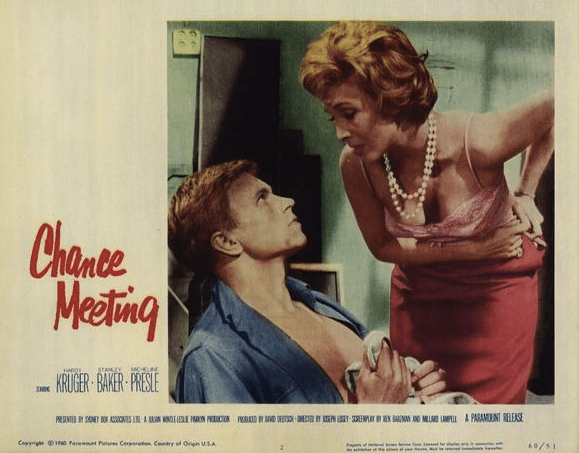
Hardy Krüger, Micheline Presle. Chance Meeting (US)
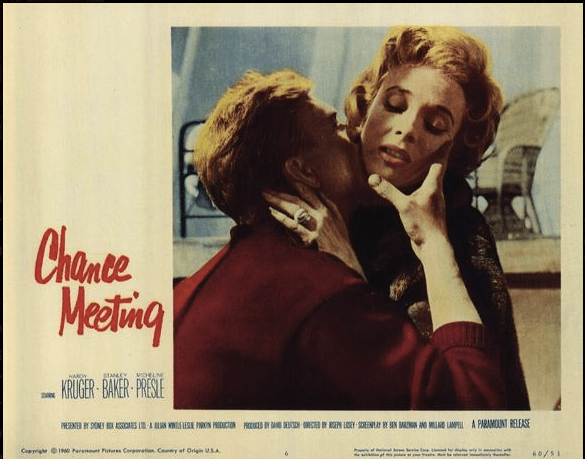
Chance Meeting is a 1959 British murder mystery film by Joseph Losey, the famous political noir film-maker. Ben Barzman and Millard Lampell were nominated for the BAFTA Award for Best British Screenplay and it shows: the plot is layered and nuanced and pulls few punches. Jan (Hardy Kruger) is an artist who has recently met a high society woman. (If this isn’t a Bryan Ferry reference, I don’t know what is). When he arrives at her apartment for an afternoon tryst (as one might expect), he calls out to his lover but gets no answer. Instead Two cops show up at the door. Jan is an uncomfortable position since he doesn’t want to give away the details of his affair. 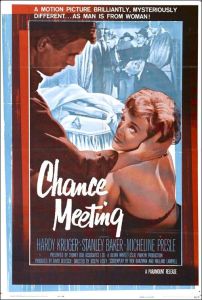 The situation worsens as he realizes his lover lies dead under the blankets on a couch: she has been murdered, and the police think it is him. The film unfolds in flashback, and we see the complications of characters who meet but barely know one another. The high-society lover turns out to be a prostitute; the artist, honest, but naive. The working class detective, noble, but ineffective. The killer, a high-level politician, getting away with murder. There is a relentlessness to the film that underlines the loneliness of the main characters; their disassociation from love and their desire for sex – chance meetings and encounters and secrets that lead to grim outcomes.
To this end we should recall the tone and distance of Ferry’s vocal decision and performance on one of Roxy Music‘s best tracks. the careful enunciation and lack of emotion in the delivery; the oppressive guitar feedback 0:38 seconds in, relentless as it rides over top of the melody crashing down with oppressive weight. This is different social worlds colliding, relentless chance meetings spinning out of control, while the killer remains disassociated, untouchable. In a completely different reading of the song – gone is the Brief Encounter enchantment of previous readings – the Bogus Man protagonist happens upon the woman he eventually kills. Sentence fragments are highlighted to emphasize the unnatural pacing of intonation and expression:
I ne/ver thought I’d see you/again [relationship over]
Where have you been/until now?
Well / how are you? [tone and delivery removed from sentiment]
How have you been? / It’s a long time since we last met [‘met’ is delivered with spite. This is a great dramatic performance by Ferry]
It seems like yes/ter/day [Counting the hours, days]
When I /first saw you [Obsessing]
In your red dress mine [Red: symbol of sex, lust, blood – the single use of colour imagery in the song. ‘Red dress mine’: the Bogus Man awakens…]
How could/ I forget that day? [Obsessing]
I know that time well spent is so rare [obviously the time wasn’t well spent at all – run lady, run! while you still can!]
It took a while for Ferry to get the song right, but he never stopped championing the piece. A definitive live version was recorded in 1973 on Viva! (released 1976); the live version has an even chillier delivery which emphasizes the hint of menace in the song, coupled with a sublime oboe accompaniment by Andy Mackay. In 1976 Ferry re-recorded ‘Chance Meeting’ (as he did with many of Roxy’s 1st album choice cuts): the sound is richer and better sounding, and has its supporters. Count me as one of them.


Titbits


David Bowie, Red Money. Bryan Ferry, Sign of the Times. The line that plays its hand in ‘Chance Meeting’ is red dress mine. The colour red is a shock, but only in hindsight, and on a close reading. This is Bryan Ferry’s Haiku moment. As you may recall, Haiku is a poetic device that juxtaposes two images or ideas, one of which acts as a “cutting word” or verbal punctuation mark. Red is the cutting word in this song as it comes as us with its seductive connotations of red (sex), dress (flesh), mine (possession) against a backdrop of languid melody and expression. For a period in late 1979 Bowie was intrigued with the colour red and used it as a symbol that could evoke a particular emotion, bringing together thematic ideas that were subliminal instead of explicit. In Lodger, ‘Red Sails’ closes side 1 (red sail action: wakes up in wrong town). ‘Red Money’ closes side 2 (red money, project cancelled: good bye Eno, Iggy, Sister Midnight). Not to be left out, Ferry himself returned to explicit colour imagery in the late 70s: in Red is the bloody sign of the times, he sang as the end of the decade approached. Lipstick ‘n leather, wear ‘n tear….
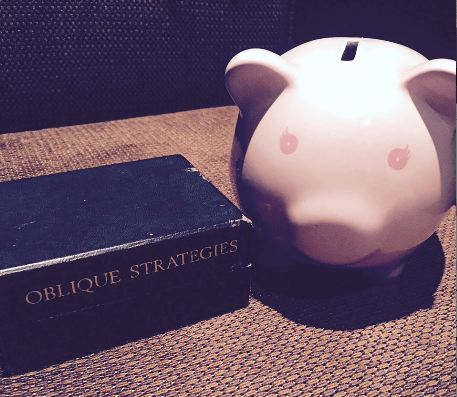
Oblique Strategies, Eno/Schmidt
My own copy (2nd edition), purchased on eBay eons ago. Today’s Card: “Do Nothing as Long as Possible.” Now they tell me.
 For Your Pleasure